 |
 |
 |
 |
Willis encourages our concern with meaningfulness…Generally
only caring human beings offer and accept feelings in this way. The
paintings may not resemble human likenesses, but they nevertheless
seem somehow to proffer human character n the abstract.
Joseph Masheck, from Historical Present: Essays of the 1970’s,
UMI Research Press
|
 |
 |
 |
 |
 |
Abstract painting is an abstraction of character or personality
as much as it is and abstraction of nature. And what holds a gallerygoer
is the best work that Robert Ryman and Thornton Willis have done recently
is the excitement of watching artists who are interested in exercising
certain possibilities that they see in art, and therefore in themselves.
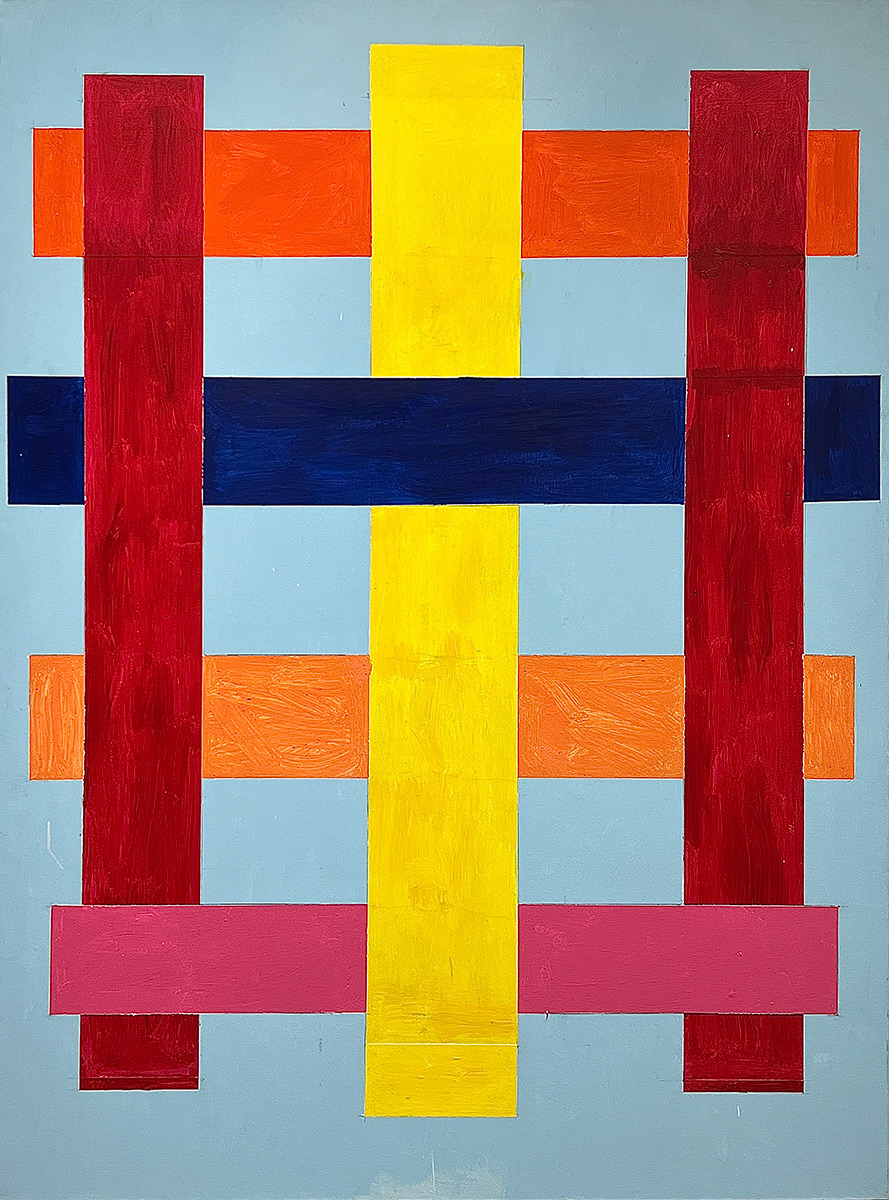
Willis’s arrays of triangular shapes, which are packed into
networks or unfurled in fan-like configurations, have a knock-about
resplendence of color, whether he is working with stained-glass-deep
reds and blues or with dusty greens and yellows of fallen leaves in
late autumn. In these new paintings Willis easily tops the formal
bravura of his work of two decades ago, when one of his large paintings
with a singular triangular form was included in an International Survey
at the Museum of Modern Art. Although Willis was always a powerful
painter, he seems to me to be a far more inviting artist now, when
he is multiplying his triangular forms, playing with different ranges
of color, using informal brushwork that has a calligraphic abruptness.
There is a fascinating mixture of delicacy and boldness to this work.
Jed Perl on Art: Unity and Variety, The New Republic, January 27,2003,
pp.24-27
|
 |
 |
 |
 |
 |
To describe 21st Century spatial concepts (in painting) is to try
and depict the basic interconnectedness of matter in which form only
appears separate.
In fact, all form struggles to maintain itself in the dynamic
flow of space and time. The essence of nature and of our own human
existence is change, movement towards or way from one form to the
next.
In my paintings the forms are locked in this flux. It is part of
the dynamic of the work and meant to be so. In this work, figure
and ground, positive and negative are all equal. There is a suggestion
of volume in the form, which continues to interest me as I work
towards depicting a kind of Biomorphic Cubism.
The way I work is to develop, intuitively, an image through a working
process over a period of time. As the image develops, I begin making
changes within that framework. The manner in which the painting
happens; how it is conceived and then developed is of particular
interest to me. Either the painting is an image or it contains an
image. In either case, concerning the integrity of painting, it
seems preferable that the image develops out of a working painterly
process, no matter how complex or simple, as opposed to the appropriation
or selection of imagery based on whim or theory.
Thornton Willis, (excerpted from exhibition catalogue), 2002
|
 |
|
|